

Through the Lens of Black Life
Photography and the Black Arts Movement Exhibition

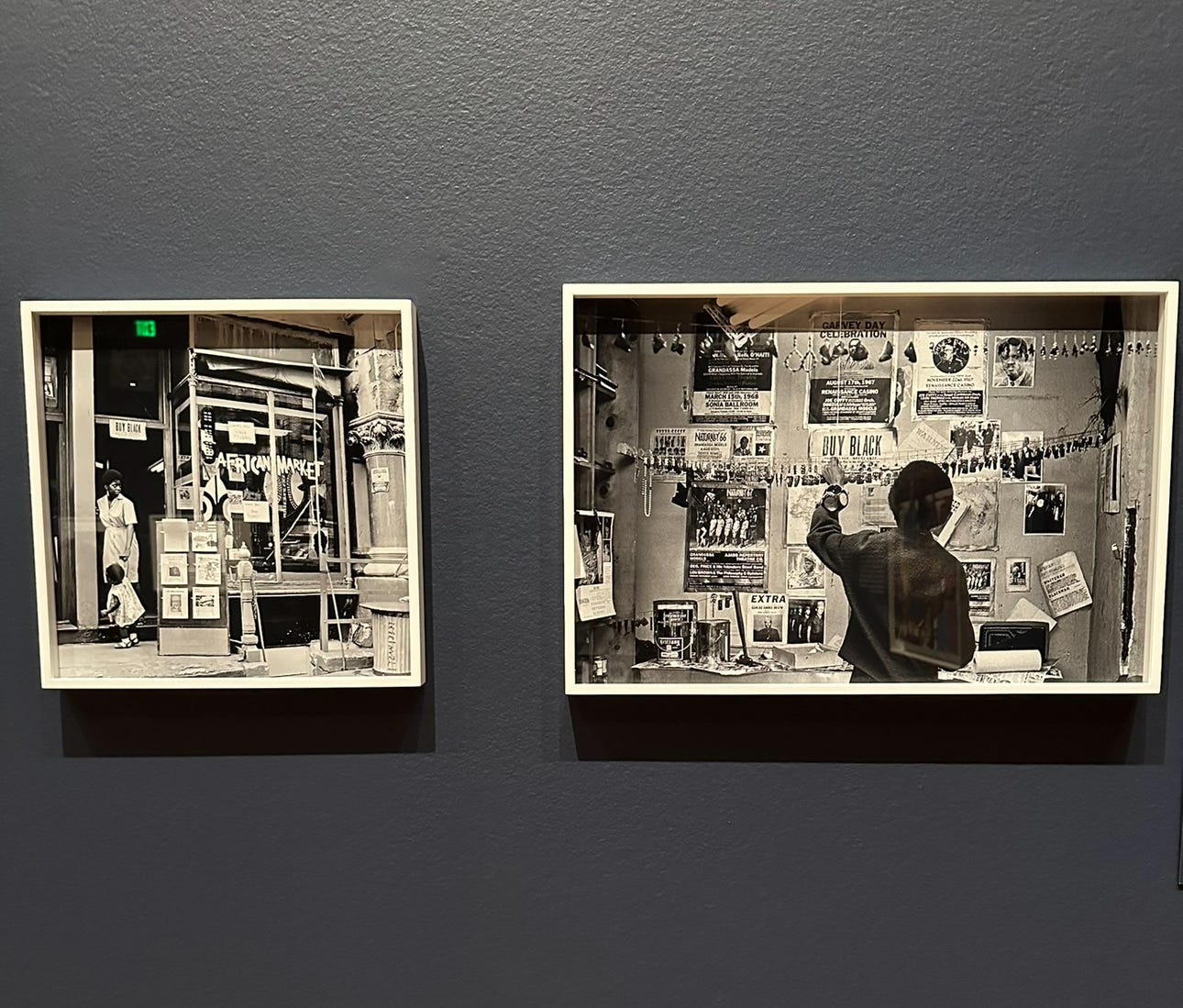
In recent years I’ve become increasingly intrigued with photography and the archives of Black photography. Maybe it’s because I frequently experience waves of nostalgia and yearn for the “good ol’ days.” Then there are the moments where I find myself wishing that I would have had more conversations with my elders about their experiences during various moments in their lives. Now that all of my grandparents are gone, and many of my elder family members, all that I am left with is photos.
As someone who grew up with both sides of my family having a plethora of photo albums filled with stills of history, I naturally became the person known in my friend group as the unofficial photo archivist. Anytime we’d have conversations recalling moments of the past, it would be known (or assumed) that I have some photos from that time. In my younger years, I didn’t even realize the value that photography eventually carries; I’ve just always enjoyed (and still do) capturing the moments, big and small. And as the daughter of a photographer, I guess the apple really doesn’t fall far from the tree. Although I enjoy capturing stills, and experimenting with photo editing, I don’t label myself a photographer. I appreciate the art form, but I don’t have the same eye and skill that the true photographers possess. What I do know, as a visual artist who paints, is that all art is a way to tell a story and document a moment in time. And for Black people, photography is the most powerful way to do that.
For my generation, and even those that follow, a lot of the connection to our history has come by way of storytelling and photographs. I think back to grade school, when learning about the Civil Rights Movement, and the images that immediately come to mind. Anytime someone mentions Ruby Bridges, beyond knowing her story of integration, her famous photo immediately comes to mind. I can’t even imagine how that story, and others, would look or feel had there never been photos to display that important moment in Black history.
With my intrigue of Black photography, I was excited to discover an exhibition at The Getty Museum dedicated solely to Black photography from the decades of my parents’ and grandparents’ youth and young adulthood. I anticipated that this would be a “cool” exhibition to explore, but I didn’t anticipate how emotionally powerful it would actually be. This exhibition explores how photography was used to tell Black stories and build community over three decades (1955-1985).


While photography is the focal point of this exhibition, it also includes paintings, poetry, album covers, and more artifacts that represent the Black Arts Movement. With over one-hundred works of art, the exhibition spans a range of voices, from known legends such as Gordon Parks, Carrie Mae Weems, and Barkley L. Hendricks, to other artists and activists you may be less familiar with. That range is part of what makes it so powerful. Exhibitions like this one don’t just evoke moments in time; they introduce us to people and works we may have otherwise never discovered.
While I have seen many amazing photos in exhibitions, I must say, this is the best photography exhibition I have experienced thus far. I also put together a short reel that gives you a little more depth into my experience, and it’s worth a watch regardless of whether you’re able to see it in person. But nothing will compare to experiencing it yourself.
This exhibition is in its final week (now-June 14, 2026) at The Getty, so if you’re in Los Angeles this week I encourage you to go check it out. If you miss out on this experience at The Getty, you can still check it out at its next destination: Mississippi Museum of Art in Jackson, MS: July 25–November 8, 2026.